Research
My research focuses on particle physics and quantum field theory. A full list of publications is available on INSPIRE and Google Scholar.
Machine Learning
Machine learning has been a part of particle physics for at least 40 years. Our group has contributed to interpretable and unsupervised approaches, as well as practical tools for jet classification, pileup removal, and weak supervision.
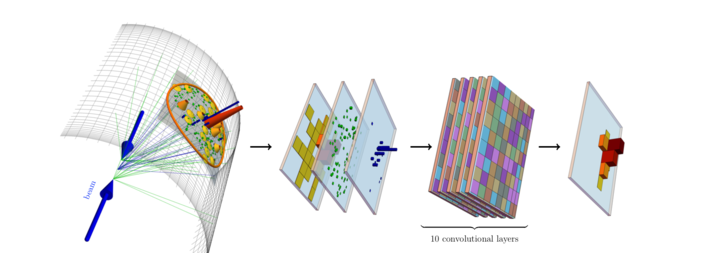
- Observable optimization for precision theory: machine learning energy correlators
- Learning the simplicity of scattering amplitudes
- Reconstructing S-matrix Phases with Machine Learning
- Neural network field theories: non-Gaussianity, actions, and locality
- Simplifying Polylogarithms with Machine Learning
- Machine learning and LHC event generation
- Modern Machine Learning and Particle Physics
- Parameter inference from event ensembles and the top-quark mass
- Challenges for unsupervised anomaly detection in particle physics
- Automating the ABCD method with machine learning
- Binary JUNIPR: an interpretable probabilistic model for discrimination
- JUNIPR: a Framework for Unsupervised Machine Learning in Particle Physics
- Jet Charge and Machine Learning
- Learning to Remove Pileup at the LHC with Jet Images
- Learning to classify from impure samples with high-dimensional data
- Pileup Mitigation with Machine Learning (PUMML)
- Deep learning in color: towards automated quark/gluon jet discrimination
- Pure Samples of Quark and Gluon Jets at the LHC
- Should artificial intelligence be interpretable to humans?
Non-Perturbative Physics
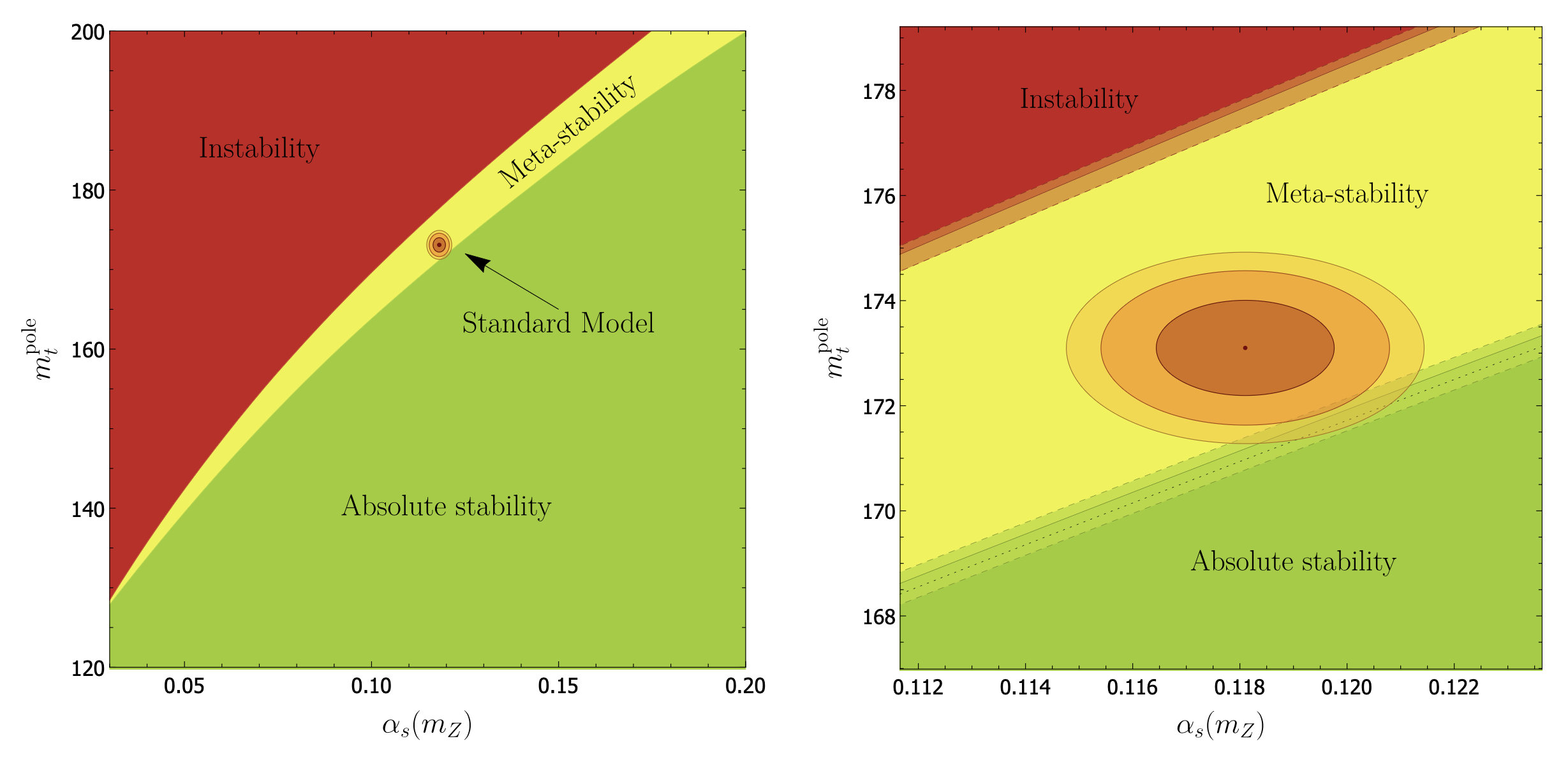
Non-perturbative effects in quantum field theory are critical for understanding phenomena beyond the reach of perturbation theory. Our group has studied the large-order behavior of perturbation theory and its connection to renormalons, as well as the stability of the electroweak vacuum. Our estimate for the lifetime of the universe: Tuniverse = 10167 years.
Renormalons and Asymptotics
Vacuum Stability
S-Matrix
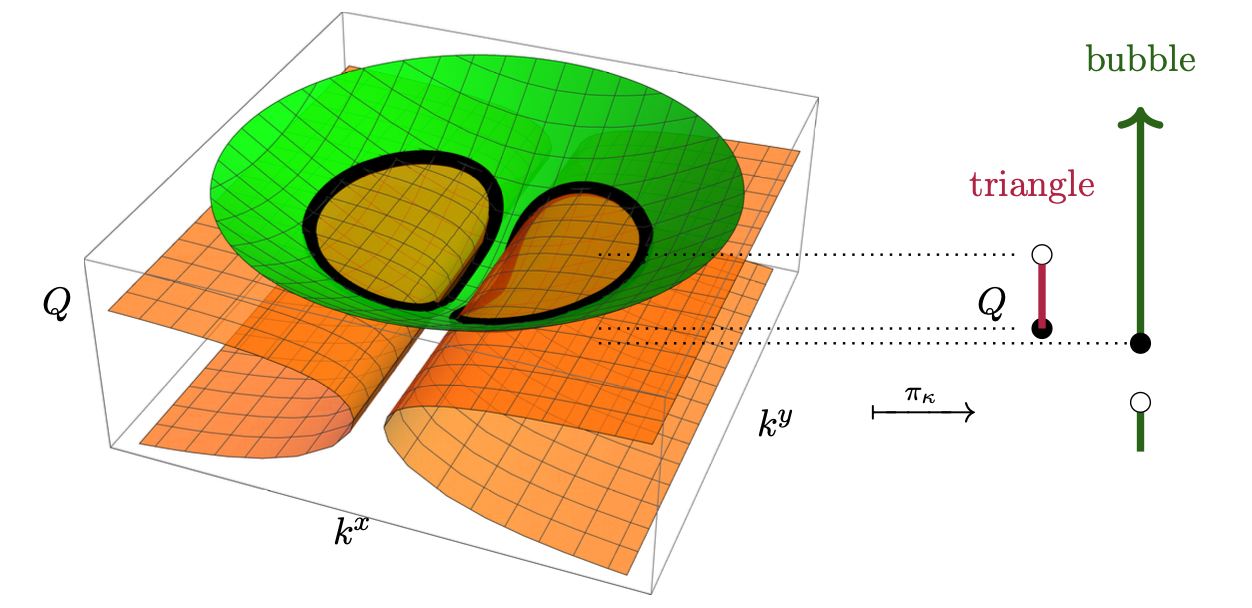
The S-matrix encodes all observable information about scattering processes. Our work has focused on understanding its analytic structure through Landau equations, sequential discontinuities, and forward scattering, as well as developing new methods for computing amplitudes and Feynman integrals.
Analytic Structure
- Applications of the Landau bootstrap
- Constraints on sequential discontinuities from the geometry of on-shell spaces
- A Finite S-Matrix
- Quark-Gluon Backscattering in the Regge Limit at One-Loop
- Implications of the Landau equations for iterated integrals
- Sequential Discontinuities of Feynman Integrals and the Monodromy Group
- An S-Matrix for Massless Particles
- Infrared Finiteness and Forward Scattering
Amplitudes and Integrals
Effective Field Theories
Effective field theories, particularly Soft-Collinear Effective Theory (SCET), provide the theoretical framework for factorizing cross sections and resumming large logarithms. Our group has proven factorization from first principles and studied its violation.
Factorization
- Factorization for groomed jet substructure beyond the next-to-leading logarithm
- Removing phase-space restrictions in factorized cross sections
- Hard-Soft-Collinear Factorization to All Orders
- The heart of factorization
- An on-shell approach to factorization
- Event Generation from Effective Field Theory
- Improving jet distributions with effective field theory
Factorization-Violating Effects
- Factorization Violation and Scale Invariance
- Collinear factorization violation and effective field theory
- Nonglobal logarithms at three loops, four loops, five loops, and beyond
- Jet Mass with a Jet Veto at Two Loops and the Universality of Non-Global Structure
Resummation
- Resummation of the C-Parameter Sudakov Shoulder Using Effective Field Theory
- NNLL resummation of Sudakov shoulder logarithms in the heavy jet mass distribution
- Sudakov shoulder resummation for thrust and heavy jet mass
- Streamlining resummed QCD calculations using Monte Carlo integration
- The two-loop hemisphere soft function
- Resummation of jet mass with and without a jet veto
- 1-loop matching and NNLL resummation for all partonic 2 to 2 processes in QCD
- Threshold hadronic event shapes with effective field theory
- Direct photon production with effective field theory
- Resummation and NLO matching of event shapes with effective field theory
Collider Physics
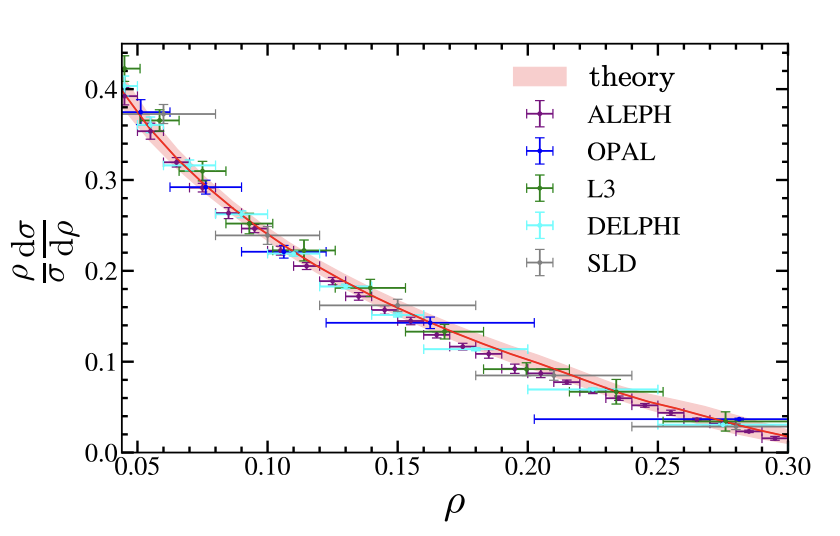
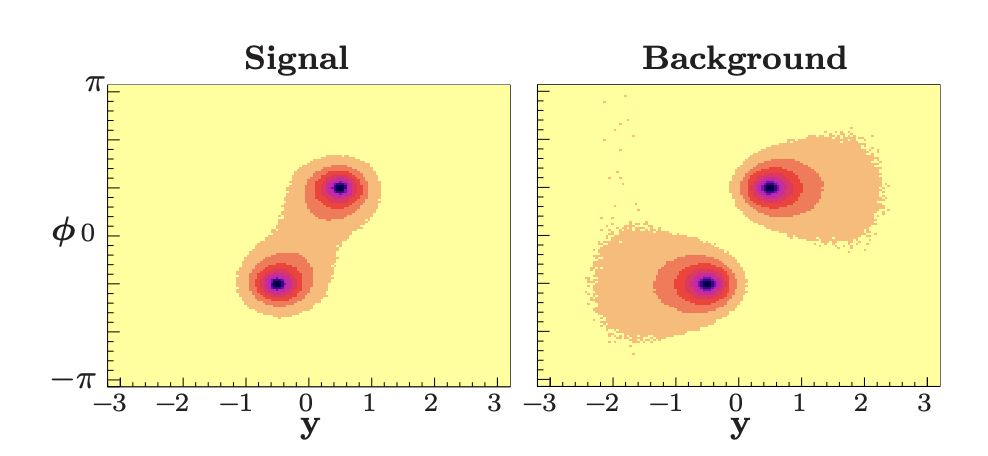
Precision calculations of collider observables are essential for extracting fundamental parameters from data. Our group has performed precision extractions of the strong coupling constant, comparisons to LHC and LEP data, and developed widely-used jet substructure techniques including top tagging, jet charge, and quark/gluon discrimination.
Precision Calculations
- Observable optimization for precision theory: machine learning energy correlators
- Precision e+e- hemisphere masses in the dijet region with power corrections
- A Precise Determination of αs from the Heavy Jet Mass Distribution
- Prospects for strong coupling measurement at hadron colliders using soft-drop jet mass
- TASI lectures on collider physics
- Precision direct photon spectra at high energy and comparison to the 8 TeV ATLAS data
- Precision physics with pile-up insensitive observables
- Resummation of Jet Mass at Hadron Colliders
- Precision Direct Photon and W-Boson Spectra at High pT and Comparison to LHC Data
- Precision Jet Substructure from Boosted Event Shapes
- Resummation for W and Z production at large pT
- Resummation of heavy jet mass and comparison to LEP data
- A precise determination of αs from LEP thrust data using effective field theory
Jets and Jet Substructure
- Reducing the Top Quark Mass Uncertainty with Jet Grooming
- Quantifying the power of multiple event interpretations
- Jet Cleansing: Pileup Removal at High Luminosity
- Jet Sampling: Improving Event Reconstruction through Multiple Interpretations
- Jet Charge at the LHC
- Quark and Gluon Jet Substructure
- Qjets: A Non-Deterministic Approach to Tree-Based Jet Substructure
- Jet Physics from Static Charges in AdS
- Quark and Gluon Tagging at the LHC
- Pure Samples of Quark and Gluon Jets at the LHC
- Multivariate discrimination and the Higgs + W/Z search
- W-jet Tagging: Optimizing the Identification of Boosted Hadronically-Decaying W Bosons
- Seeing in Color: Jet Superstructure
- Top Tagging: A Method for Identifying Boosted Hadronically Decaying Top Quarks
- Constraining Light Colored Particles with Event Shapes
- Improving Jet Distributions with Effective Field Theory
Beyond The Standard Model
Our group has explored physics beyond the Standard Model, including massive gravity as an effective field theory, the deconstruction of extra dimensions, warped extra dimensions for understanding the hierarchy problem, and BSM phenomenology at colliders.
Massive Gravity and Deconstruction
- Infrared Lorentz violation and slowly instantaneous electricity
- Discretizing gravity in warped spacetime
- Massive supergravity and deconstruction
- Discrete gravitational dimensions
- Constructing gravitational dimensions
- Effective field theory for massive gravitons and gravity in theory space
Warped Extra Dimensions and AdS/QCD
- An Eta primer: Solving the U(1) problem with AdS/QCD
- Tensor mesons in AdS/QCD
- Entropy area relations in field theory
- Unification and the hierarchy from AdS5
- Quantum field theory and unification in AdS5
- The Emergence of localized gravity